VT Translines Review: I’ve Ridden the Burlington to Albany Bus Twice
Updated September 2026: I’ve now ridden VT Translines twice, once from the Burlington airport at 5 AM and once from Rensselaer back up to Vermont. The second time I paid cash, and I’d do that again. More on why below.
I got to the Burlington airport curb around five in the morning, ten minutes ahead of my bus, in the dark, hoping I was standing in the right place.
A few minutes before 5:13 AM, a Vermont Translines coach pulled in, the driver checked my name off a printed list, and I was on my way to Albany.
This bus covers the Burlington to Albany route in about the same time Amtrak’s Ethan Allen Express does. While it’s the same corridor, it has a lot of differences. It hits lots of stops in Vermont and a few more in the Albany area, it has two daily buses, and, well, it’s a bus.
The first time I rode Vermont Translines, I took it from the airport curb to the Amtrak platform at Rensselaer. Then I hopped on an Empire Service Amtrak to get to NYC. I picked it over the Ethan Allen on this day because I wanted to get into the city as early as possible, hence the 5:13am bus.
Here is everything I noticed across both rides and what you need to know about riding VT Translines.

Finding the stop at the Burlington airport
This is the part that stresses people out, especially if you’re on an early morning bus.
The stop sits near door 4, right before the parking garage, on the right as you pull in. It is the same curb the local bus uses, so what you are looking for is a sign that says BUS STOP. There is no Vermont Translines branding on it at all. The published schedule just says “baggage claim,” which is accurate but not much help at 5 AM.
I showed up ten minutes ahead and that was plenty. The bus pulled in with time to board and pulled out promptly at 5:13. Do not be late, but you do not need to be early either.
If you do end up there well ahead of time, wait inside the airport. If you are only a few minutes early, the curb has cover from the rain.
Booking is easy, and you have a few options.
Vermont Translines uses the same booking platform Peter Pan does. I recognized it immediately. Whatever that software is, it works, and I mean that as a compliment, because plenty of regional bus sites do not.
It emails you your ticket and lets you download it right there. You get a QR code. But here is the thing nobody tells you. When you board, the driver is holding a printed list with your name on it and just asks you to confirm. The QR code never came up.
VT Translines Has Fixed Pricing
I’ll talk more about this in a minute, but you pay the same for VT Translines no matter when you book. It’s a commuter service. You can see the full fare table for VT Translines here on their website.
When you book online, you pay a $2.50 fee, which is annoying, and avoidable if you pay cash (more on that below). But I’ll take the fixed pricing. It’s not like this for the Amtrak trains that go through VT. There are no bag or seat fees. The first time, I paid $44.50 total to get to Albany.

Skip the online fee and pay cash
The second time I rode it, heading north, I didn’t book ahead. I’d come up from NYC on Wanda Coach, which drops you at a curb on Central Ave in Albany, then took a Lyft across the river to Rensselaer to catch the bus. I paid the driver in cash ($42 to the BTV airport) and got on. No ticket, no receipt, and the driver didn’t even ask for my name.
My first bus was nowhere near full. Online, you pay a $2.50 fee on top of the fare, and the ticket can’t be refunded or changed. So why pay more, and pay earlier, for a seat I didn’t need to reserve?
Look up your fare on the VT Translines fare chart and bring exact change. The driver won’t make change.
The trade-off is that cash doesn’t reserve you a seat. If the bus is full, you wait for the next one, and there are only two a day. You also give up Amtrak’s connection guarantee, which only applies when you book the bus and train together on Amtrak. So I’d still book ahead on holiday weekends, when the colleges along the route move in or out, or if you’re connecting to a train you can’t miss. Any other day, bring cash.
You can book it as an Amtrak connecting bus, and you should at least price it out
This route shows up on Amtrak as a Thruway connection, so you can buy the bus and the train on one reservation. I wrote a whole piece on what an Amtrak connecting bus is and what to expect if you want the full picture.
The reason to do it is the guarantee if you miss a connection.
Book it as a connecting bus and Amtrak protects the connection at a fixed price. If the bus runs late and you miss your train, Amtrak rebooks you. Book the two legs separately and a late bus is entirely your problem.
However, there are a few downsides to this too.
Because Empire Service Amtrak prices fluctuate, Amtrak will only show you the price of the next-closest Amtrak. That may be significantly more. I have a few strategies for cheap Amtrak tickets that help here.


The point here is just to check before you book. The VT Translines portion of the route has a fixed price, but the train may vary (or bus, if you’re connecting to Greyhound, Flix, or Trailways at the Albany Bus Terminal). I compared every Albany to NYC option, train and bus, in my NYC to Albany guide.
I went with the two separate bookings and built my own buffer instead, which I will get to. Sometimes the guarantee is worth the difference and sometimes the difference is small enough that you take it for the peace of mind.
What about booking through Greyhound or Busbud?
Greyhound sells this bus too. I had a Greyhound voucher from a canceled trip, so I tried to use it. Greyhound’s app quoted me $503. I’m guessing that’s a Greyhound glitch, not a real fare, but I wasn’t going to find out.

If you want a way to get your money back when a connection falls through, book VT Translines on Busbud. Busbud won’t link it to your next bus or train either, so you’re still booking two tickets. But you can cancel up to 15 minutes before departure. One catch: depending on the operator, a refund can come back as Busbud credit instead of cash. I get into the details in my Busbud review.
Watch out for the four Burlington station codes

If you’re booking on Amtrak, it’s also confusing because there are four different station codes for the Burlington area.
- BTN is Burlington Union Station downtown. That is the train. The Ethan Allen Express goes there and the bus does not.
- BLT is the Burlington Downtown Transit Center on Pearl Street. That is where the intercity buses come and go. It’s walking distance from the train station, but still, a different station on a different street.
- BTV is the airport stop in South Burlington, which at least matches the airport code you already know.
- ESX is in Essex Junction and is served by the once-daily Vermonter Amtrak train in each direction. It goes through Connecticut and takes longer to get to NYC and continues all the way to DC. In this case, it’s not relevant, as besides Burlington it serves completely different destinations.
Who rides buses across Vermont
I spent the whole walk to the curb wondering who else signs up for this. More people than I expected, as it turns out. I had a full row to myself, don’t get me wrong, but it had a decent amount of commuters.
Outside peak travel days, this is a safe bus to buy last minute, and the price is fixed either way.
I noticed people getting on and off a lot, so it really serves commuters more than people doing intercity travel like me, but it works for both.
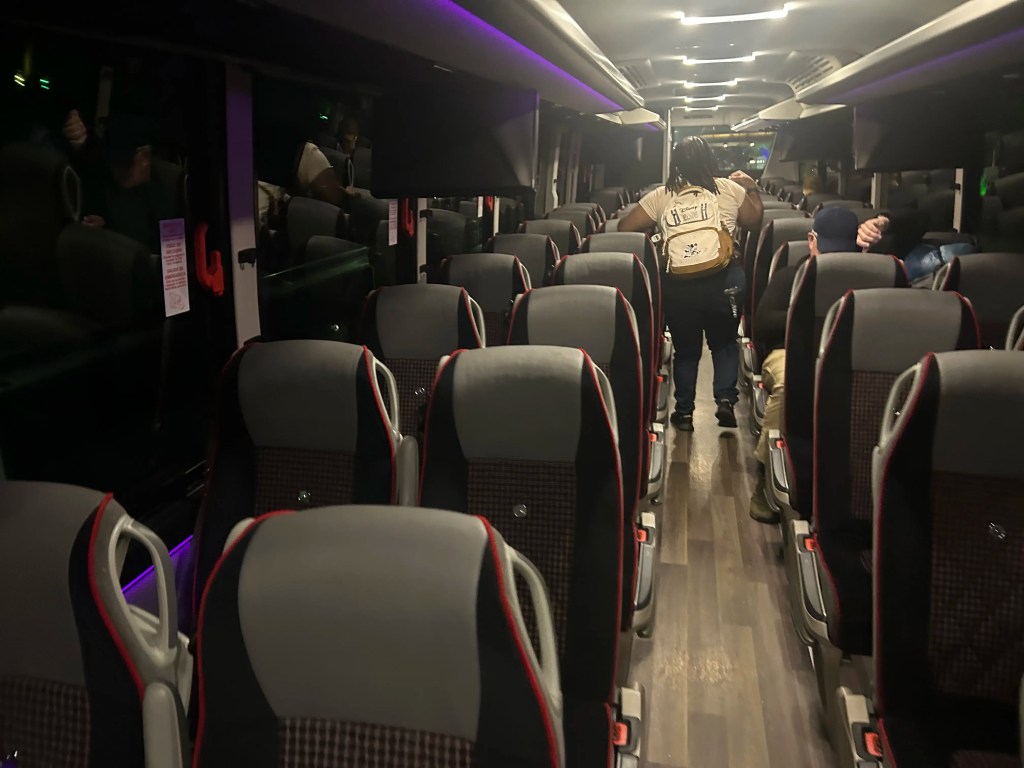
The bus itself is pretty nice
Both times, I got the same kind of bus: a new, modern, pretty spacious Mercedes coach.
The seats recline a lot. More than I have gotten on most intercity buses.
Legroom is not Amtrak legroom, obviously. Buses rarely compete in this respect. But I had noticeably more room than I get on most Flix and Greyhound coaches.

Both of those run mixed fleets and their newer buses are better than their older ones, so your mileage varies. This one was toward the good end of anything I have ridden.
There is a tray table, though it is small and I could not use it for my laptop, and my laptop is not a big one.
The outlets are standard plugs, right in front of you, and they work.
There is wifi. Here is the catch, and it is the same catch Amtrak has. The wifi runs off cell service, and most of this route is rural Vermont. On my first ride, heading south, it mostly did not work.
On my second ride, heading north, I gave it a real shot. Near Albany it was decent. Forty-eight minutes after we left, a speed test clocked 0.56 Mbps down and 0.14 up. That is enough for email and basic browsing, and not much else. After that stretch, I switched to my phone’s hotspot.

Download what you need before you board and do not plan a workday around it.
On noise, do not expect a library. An older woman a few rows up took a phone call and held it for a while, and nobody said anything. This is not a quiet car. Bring headphones.
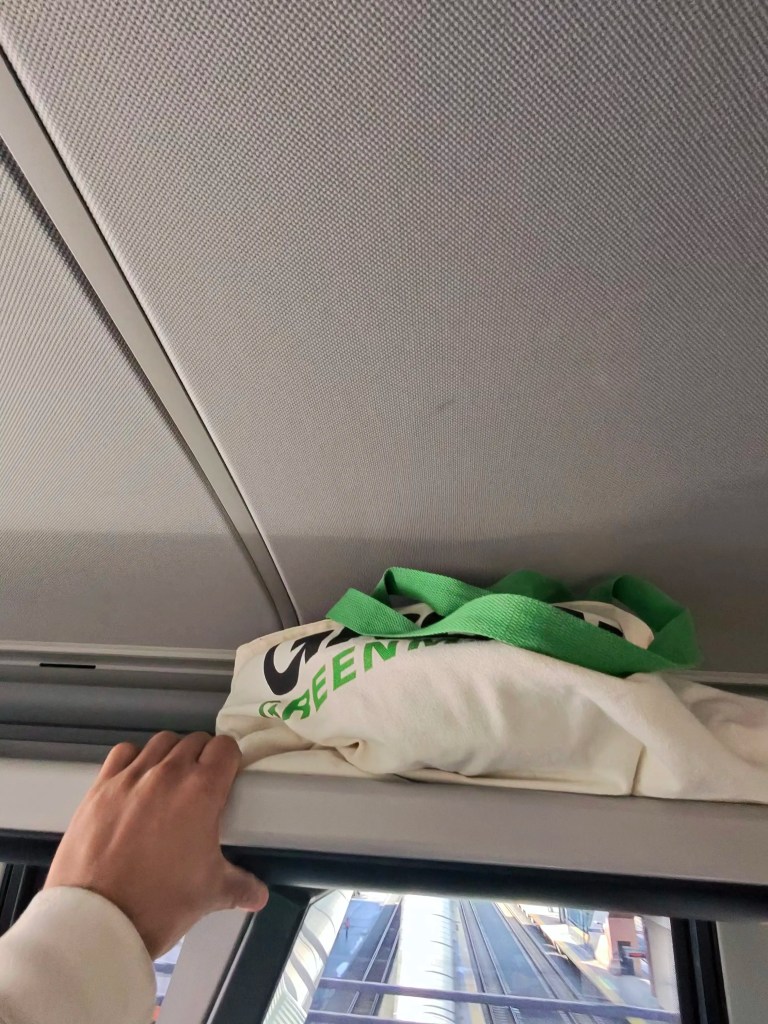

It is wheelchair accessible
The coach had a ramp and a gap in the seating where a few seats would normally sit, which is the securement space. You can take this bus as a wheelchair user.
I mention it because almost nobody writing about intercity buses bothers to check, and for a lot of people that one fact decides the whole trip.
Big luggage goes underneath, same as almost every intercity bus. Backpacks and small stuff come up with you.
The bathroom
There is one, and it flushes, which for a bus is upscale.
What I always check is whether it is stocked with toilet paper and hand sanitizer. In this case, both were a yes and I saw an extra roll. That is a small thing that tells you a lot about how a company runs its buses.

Sleeping on this was harder because of the windy roads
I have slept fine on plenty of buses.
Most overnight and early morning buses I take run straight down an interstate.
This one winds along local Vermont highways for most of its length. All that gentle swaying that looks so pretty on a map turns into four hours of your head rolling around.
Bring earplugs, a travel pillow, and an eye mask or a beanie pulled down over your eyes. I keep a running list of what I pack for a bus trip and every item on it earned its place on a ride like this one.
What you see once the sun comes up
At 6:49, somewhere between Brandon and Rutland, the sky went pink over the Green Mountains and the whole trip changed character. That is the payoff for the early alarm, and it is the reason I will stop complaining about the coffee in a minute.
The Ethan Allen runs this same corridor and the views are lovely from the train too. But the bus is on Route 7, closer to the towns, running past farms and general stores instead of behind them.
Every stop between Burlington and Albany
One of the best arguments for the bus is that it stops where the trains don’t, so you can get closer to your final destination.
| Stop | What it actually is |
|---|---|
| Colchester, VT | Park and Ride on Brentwood Drive, off I-89 Exit 17. |
| Burlington downtown | Downtown Transit Center, south side of Pearl Street just east of St. Paul |
| Burlington Airport | Curb by baggage claim, near door 4, before the garage |
| Ferrisburgh-Vergennes | VT Park and Ride just west of the Route 7 and 22A junction. Where Amtrak stops. |
| Middlebury | Storrs Avenue at Franklin Street, on the Middlebury College campus. |
| Brandon | In front of the Brandon Inn, 20 Park Street. This one was random. |
| Rutland | Marble Valley Regional Transit Center, 102 West Street. A typical U.S. bus station. |
| Wallingford | Cumberland Farms, 309 North Main Street. This was the weirdest. Nobody got on or off. |
| Manchester | Bus parking at the rear of the Langway dealership lot |
| Bennington | Green Mountain Community Network transportation hub, 215 Pleasant Street. This had a station. |
| Rensselaer, NY | Amtrak station, 525 East Street. First floor, through the sliding doors one level below the main entrance. |
| Albany, NY | Bus terminal, 34 Hamilton Street |
| Albany Airport | Nearest curb to the terminal, far south end, under the VT Translines sign |
Some of these are proper stations. Rutland and Bennington are transit centers with a roof and a door. Most of the rest at least have shelter. A few are a curb.
If you are riding this in January, look up your specific stop before you go. Standing at the Cumberland Farms in Wallingford at 7:30 AM in February is a different trip than standing inside the Marble Valley Transit Center.
One thing I appreciated. These stops are in town centers and at transit hubs, not scattered across suburban strip mall parking lots the way a lot of intercity bus networks end up.
The driver change at Rutland
Drivers swap at Rutland in both directions. Both times, we sat for about ten minutes.
You don’t get off and there’s nowhere to go, so make sure you bring your coffee/snacks with you.
Making the Amtrak connection at Rensselaer
This part confused me for a minute, so here it is plainly.
The bus drops you at a side door on the first floor. The main station is upstairs. You take the elevator up.
There is a sign at the main entrance.

We pulled in about four or five minutes behind schedule. There wasn’t any traffic, but with buses you never know.
Catching the bus at Rensselaer, heading north
The bus picks up in the same spot it drops off. From the main entrance, take the elevator (on your right as you walk in from outside) or the stairs (through a door on your left) down to the first floor. Go through the automatic sliding doors and you’ll see where the bus pulls up.
My 1 PM bus left right on time.
Should you build in a buffer?
On paper the 9:45 arrival connects to a 10:05 Empire Service train. I booked the 11:19 instead and gave myself an hour and a half, for three reasons.
One, Albany-Rensselaer is a fine place to sit. It is clean, it has seating and food and bathrooms, and I can work there without hunting for an outlet. Killing an hour there is fine.
Two, it is a bus. You never fully know.
Three, it was a lot cheaper than the 10:05 train.
We arrived four or five minutes late, so the 10:05 would have worked.
My northbound ride was a different story. It left Rensselaer right on time at 1 PM, and at first the driver held to the schedule. We pulled into Bennington at 2:01 and waited until the scheduled 2:05 to leave. As someone who has run for too many doors a minute before they closed, I appreciate that. It was standard practice at every stop.
Then the bus started slipping. We left Manchester at 2:49, nine minutes behind. We got to Rutland at 3:37, swapped drivers, and left at 3:47, nineteen minutes behind the 3:28 on the schedule. At Middlebury we took a ten-minute break, and we could get off to stretch. We left at 4:50, twenty-two minutes late.
I couldn’t tell you where the time went. As far as I can tell, Vermont Translines doesn’t publish on-time data, so this is just my two rides. But I’d plan on arriving 5 to 20 minutes late.
That said, the route doesn’t touch a single stretch of heavy traffic. There’s no metro area bottleneck between Burlington and Albany. So when it runs late, it’s by minutes, not hours.
The buffer question comes down to how you booked. Book it as an Amtrak connecting bus and Amtrak owns the problem, so you can cut it closer. Book the two legs separately, which is what the math pushed me toward, and you are the one absorbing a late bus. If you pay cash on board, you’re in the separate-bookings camp too. You either pay a little more for the guarantee or you pay for it with an hour of your time at Rensselaer.
I took the hour. I like that station.
Why this route exists, and why that matters
All right, time for me to give you nerds my urbanist thoughts on this route.
First, it’s managed by Premier Coach, a popular private bus operator in Vermont. They have a contract with the state to run this public-private partnership. The reason Vermont can run this is through federal grants. It is literally the only way that you can get to and from many different population centers in Vermont without a car.
Two runs a day in each direction is decent frequency for rural intercity transit, and it exists because the state is paying to keep a corridor connected, not because Brandon and Wallingford pencil out on their own.
I watched this subsidy do its job, as people got on and off at almost every stop. Brandon, Manchester and Bennington all had riders stepping down onto the sidewalk. Only Wallingford went by without anyone moving. These are not ghost stops padding a timetable. They are towns with no train, no airport and, for a lot of people, no car.
This route also prioritizes the transit connections. It hits two airports, two Amtrak stations, and two bus terminals. In short, it expands the network. It means that I could get to New York earlier than I would have been able to otherwise.
I ride a lot of American intercity buses. Most of them are private companies trying to pull it together on their own.
Transit is for rural communities too
I think a lot of you would agree with me that public transit is generally good. Fewer cars on the road means less traffic, less air pollution, lower costs for people. You may agree with me on that, but not at the cost of too much public subsidy. That’s a reasonable stance, but for me, we have to look at what we’re comparing it to. Driving is also very heavily subsidized, for a worse outcome (in my opinion), as I outline in this article on the 27 hidden costs of cars.
Yes, it’s true, decent public transportation takes public money, and we will get what we pay for. We’ve invested in highways and have been rewarded with traffic, car payments, and reliance on oil.
This is a public service that serves rural communities that transit rarely does. It will only improve for everyone if we keep investing in it, in strategic ways that make sense for our communities.
What it cost me, Burlington to Penn Station
Let me put the real numbers down, because this is where I expected the bus to win and it is more complicated than that.
- $44.50 for Vermont Translines, BTV to Rensselaer
- $41 for the Amtrak Empire Service, Rensselaer to Penn Station
- $85.50 all in
On my second trip, heading north, I paid cash to the driver at Rensselaer. The fare to the BTV airport is $42, with no online fee.
The Ethan Allen, one seat the whole way, usually runs about $75 on a quiet weekday if you book a bit ahead. So on a good day the train is cheaper than my bus-plus-train routing. I want to be straight about that.
But the Ethan Allen is dynamically priced, and on plenty of days it climbs past $100 and up toward $125. My bus fare does not move. It is $44.50 on a Tuesday in March and $44.50 on the Sunday of Labor Day weekend.
So the pitch is not that this route is cheaper. The pitch is that it has a ceiling. When Amtrak is reasonable, take the train. When you pull up the Ethan Allen and it says $125, you have a fixed-price alternative that gets you to Albany in the same four and a half hours and hands you most of a day on the other end.
That is a better deal than it sounds like, because the days Amtrak prices high are exactly the days you most need to travel.
VT Translines versus the Ethan Allen Express
I reviewed the Ethan Allen Express and called it the best NYC to Burlington option, and I stand by that for most people on most days. But this bus beats it on a few specific things.
| VT Translines | Ethan Allen Express | |
|---|---|---|
| Leaves Burlington | Very early morning and early afternoon, from the airport or downtown | Once a day, mid morning, from Union Station |
| Runs per day | Two each direction | One each direction |
| Burlington to Albany | About four and a half hours | About four and a half hours |
| Pricing | Fixed. $42 to $43 to Albany depending on your stops, plus a $2.50 fee if you book online. Your train fare is extra. | Dynamic. To NYC it’s about $75 on a quiet weekday, $100 to $125 on a busy one, so it’s comparable but varies. |
| Vermont stops | Vergennes, Middlebury, Brandon, Rutland, Wallingford, Manchester, Bennington This serves places Amtrak doesn’t. | Vergennes, Middlebury, Rutland |
| Comfort | Good for a bus | Better. It is a train. You have a cafe car. |
| One seat to NYC | No, you transfer at Rensselaer | Yes |
Frequency and time of day. Two departures beats one, and the early one unlocks a whole different kind of day.
A price ceiling instead of a price gamble. The bus fare never moves. However, if you are riding all the way to New York, the Empire Service leg out of Albany is dynamically priced too, so you are not escaping that entirely. You are capping half the trip, not all of it.
Where you can get on and off. Bennington, Manchester, Brandon and Wallingford have no train at all. If you live in or are headed to one of those, this is not a comparison. It is the only option. The same goes for those airport connections.
The train wins on comfort and on not making you change vehicles. If I am not in a hurry and the fare is reasonable, I take the train.
If you’re weighing every option, I broke down the four ways to get from NYC to Vermont on transit.
Who should take this bus
Take it if you want to be in New York or Albany by early afternoon, if you are going to a Vermont town the train skips, if you want a price you can count on, or if you are connecting to a flight out of Albany.
Skip it if you cannot sleep on a winding road, if you have a tight connection you booked separately, if you are traveling with kids who will not survive a 4 AM wake up, or if you need to work online for the whole ride. The wifi will let you down.
I would do it again. All else equal, I prefer the train. But the next time I need to be in New York before the afternoon is gone, or the next time Amtrak quotes me $125 for the privilege of leaving Burlington at ten in the morning, I know what I’ll book.
Frequently asked questions
Does the bus stop at the Burlington airport?
Yes. Near door 4, at the same curb the local bus uses, right before the parking garage. Look for the sign that says BUS STOP, because there is no Vermont Translines branding on it.
Can I book Vermont Translines on Amtrak?
Yes. It shows up as a Thruway connecting bus, so you can put the bus and the train on one reservation. You can also book direct on the Vermont Translines site.
Is there wifi?
There is, but it runs on cell service and most of the route is rural Vermont, so do not count on it. On my northbound ride it handled basic browsing near Albany, then slowed to a crawl. Bring a hotspot or download what you need.
Is there a bathroom on board?
Yes, and it flushes and it was stocked.
Is the bus cheaper than the Ethan Allen Express Amtrak?
My bus plus train came to $85.50 and the Ethan Allen often runs about $75 on a quiet weekday. But the bus fare is fixed and the train’s is not, so on the days Amtrak climbs past $100 the bus routing saves you money.
Is it wheelchair accessible?
Yes. My coach had a ramp and a securement space where a few seats would otherwise be.
Is there a bag fee?
No. Big bags go underneath and small ones come up with you, at no extra cost.
Can I get off at Rutland during the driver change?
No. It is a crew swap of about ten minutes and you stay on the bus. Bring your own coffee. Heading north, there was also a ten-minute break at Middlebury, and there we could get off.
How early should I get to the stop?
Ten minutes was plenty. The bus pulled in with time to board and left promptly at 5:13. Do not be late, but you do not need to stand there at 4:45 either.
Does Vermont Translines run on time?
Mostly within 20 minutes. Southbound, we got to Rensselaer four or five minutes late. Northbound, we left on time and were 22 minutes late by Middlebury. Plan on 5 to 20 minutes.
What happens if the bus is late for my train?
If you booked it through Amtrak as a connecting bus, Amtrak guarantees the connection and rebooks you. If you booked the two legs separately, that is on you, which is why I build in a buffer.
Is it cheaper to book through Amtrak or direct?
When I checked, booking the bus direct and the train direct came out cheaper than one Amtrak itinerary. That will not be true every time, so price both. Cheapest of all is paying cash on board, if the bus has room.
Can you pay cash on Vermont Translines?
Yes. You can buy a ticket from the driver with exact change if there’s room. You skip the $2.50 online fee, but your seat isn’t guaranteed and you don’t get Amtrak’s connection guarantee. I didn’t get a ticket or receipt. I handed over the cash and got on.
Where does the bus pick up at Rensselaer?
On the first floor of the Amtrak station, in the same spot it drops off. From the main entrance, take the elevator on your right or the stairs through the door on your left, then go through the automatic sliding doors.
What is the difference between the two Burlington stops?
One is the Downtown Transit Center on Pearl Street, station code BLT. The other is the airport, code BTV, which is in South Burlington. They sit about fifteen minutes apart on the schedule and Vermont Translines warns you to pick carefully, because missing one does not mean you can catch the other. Neither of them is BTN, which is Union Station and serves the Amtrak train. Confusing, I know.

2 Comments